To AI Or To Not AI

I am so late to the trend, but in all honesty, I’ve enjoyed spending time seeing how the use of AI has been playing out to discover what its best uses could be. I’ve always been a cautious techie, loving the discovery of new innovation, but always waiting for a bit to see how the reviews come in before I consider jumping in on a new piece of tech. AI has definitely been one newer tool that I can see so many negatives for, but also..soooo many positives.

Let’s talk about the downsides first. First, who saw the research study by MIT about how overuse of ChatGPT can greatly affect the brain? From the article, it says, overuse of AI can lead to severe cognitive debt, lack of originality, and severe problem solving and critical thinking deficits. That’s a lot of negatives isn’t it? With AI it makes it easier for people to ask AI to do anything for them. It’s like a bully asking the class nerd to do all of their homework, or having that overly smart friend that answers all the questions for you before you even have time to think. It tempting to not put much brain effort into a project and using AI to create whatever, whenever and pass that off as original work. The catch is, AI is still a computer that needs to learn. It doesn’t have the option for emotion, it doesn’t have the capability to know everything about a subject or to create something from just a few short lines of suggestion. There is a large margin for error still and requires the human touch to check for facts, add a touch of emotion, and to check for errors. AI could get you started, but it can’t do it all for you.

We also need to remember the privacy aspect as well. With such strong student privacy requirements in school districts, AI tends to keep a lot of information it’s given in order to learn and give better answers. Just asking what it knows about me is a weird feeling. You have to be careful about what information you feed the machine or it could quickly violate your privacy rights and one that happens, it’s hard to fix that.

But, then there are positives. Imagine having a creative collaborator always at your fingertips. Ready to bounce ideas off of, answer your questions, or you can even have it be like me and have it check your grammar and spelling. It could help become a hugely detailed search engine customized to your needs, check your detailed data analysis documents, even help you finesse your marketing copy, and so much more.

Just in the last month I’ve used AI for:

  • Helping me create an outline for an article.
  • Analyzing Google Form Survey data.
  • Helping me answer random questions that Google could never.
  • Finessing some copy I was writing AND checking grammar and spelling.
  • Even helping me come up with ideas for an upcoming workshop.

That’s just what I’ve done, through conversations I’ve had with teachers across the country, there are some wicked cool things they are using AI for to create core memory learning experiences for their students. A lot of suggestions tend to be in the “lesson planning” stage of learning instead of during actual instruction, but when it comes to safely and effectively integrating new tools into education, that tends to be the trend anyway with teachers trying it first before students get involved.

It took decades for education to adopt technology and create policies for best use. New breakthroughs take time to be adopted into instruction.

So how is it being used now in schools? What kinds of ideas can you take and start trying yourself?

  • Did you know it’s really easy to have AI help you create lesson plans or activities quick and easy? ChatGPT and MagicSchool.AI are really easy to use that can help you achieve this. You can ask the tools specifically what you’d like the students to achieve, what you’d like the lesson to be about, and what resources you have available, and they can produce ideas for you. (WARNING: If you try this, check what the tools actually give you, they will still need editing and a lot of finessing before they are fully lessons. Don’t just print off what the tools give you and call it a day.)
  • Have an AI generator to use as a search engine for your students. (For those that have districts strict on student privacy, talk to your IT department about getting a site license for your own ChatGPT hub, there are more ways to lock the private “bubbles” down.) AI engines are on the safer side when it comes to more confined and reduces rogue results for students to search, so instead of an open resource like Google where anything can pop up in this weird internet universe.
  • Creating resources for lessons can be so cool. I recently got to sit down with a teacher who created amazing visuals for their students that helped take them on an adventure without ever leaving their classroom. You can create videos, pictures, and songs from scratch with just a few prompts. Want to show your students what a grand ball may have looked like during the Victorian era? Got you covered. How about help you making a ton of visuals to allow students to talk to Mozart and experience a model of how their life might look based on facts found online. Using generators like Suno also allow students to experience a song writing collaborator, it gives them a venue to experiment with lyrics and genre as they work through the process.Song generators like Suno can be an interactive experience to explore some of the ins and outs of songwriting.

The AI innovation is not something that should be debated whether or not it should be accepted into the education universe, it should be debated how. As with many new tools that have come and gone, we know they can’t be completely erased from education, but how they are incorporated makes the difference.

How do you incorporate AI into your instruction?
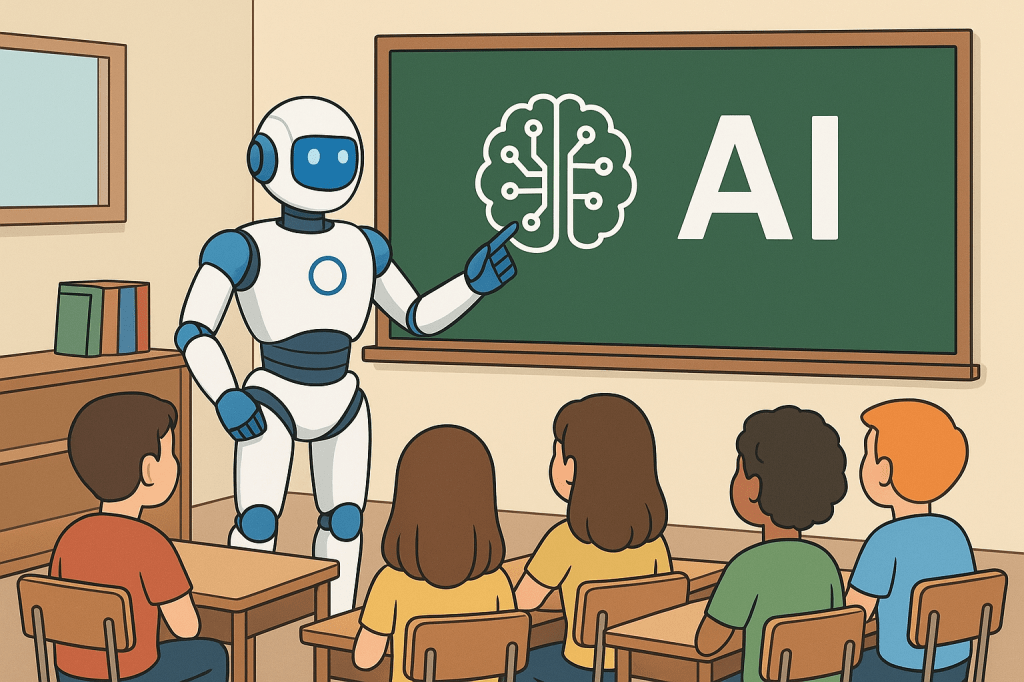
Made by AI

Discovery Learning

If I hadn’t gone into teaching music, I definitely would have become some sort of STEM or science teacher. I looked at Ms. Frizzle as an icon who took experiential and discovery learning to a whole new galaxy. Students crave independence and are more engaged when they have the freedom to get their hands a little messy.

If I hadn’t been a music teacher, I would have been the classroom teacher that constantly had her kids out exploring the community, we would have gone everywhere I could have taken them. Giving students all the opportunities to discover new things, find things they get excited about, and be encouraged to dive in further lights that fire in them that could lead to years of innovation.

Discovery learning is about choice, it’s about flexibility, it’s about motivation, it’s about opportunity, and it’s about collaboration. Learning can be more than instruction, it can be time to work together or work separately to explore what interests them.

So,

1. Give them opportunities to steer their own ship. Doesn’t have to be all the time. Just give them the opportunity to choose when it’s right.

2. Ask for the minimum, motivate them to give the maximum. Motivate them to give 100% even though you might only ask for 70%. Everyone will get there a different way too, and that’s ok.

3. Give them grace and yourself flexibility. It won’t always go the way you want or hopped it would, but that’s ok. They are going to make mistakes and get messy, but sometimes, the best lessons come from the mistakes we make.

Be ready to guide, counsel, and push, all your students won’t take the same road to get down to the same place. But, you can help them navigate those roads whether they be straight or windy to get to the end.

Music Drives the Story

Have you ever sat and listened to the music playing and became completely engaged with it, not realizing the mixture of music and words create a story that has pulled you in to far you need to hear more? I sit here listening to a new to me musician on Spotify who has done that to me all afternoon. I can’t get enough. So I started thinking, how can you encourage that musical story telling in your classroom?

Here are some ideas to get you started!

  • Movie Making – You could make a whole unit out of scoring movies and foley artists with found sounds. Create a short list of movies that might be familiar to your students. Have them choose a scene that speaks to them and rewrite the music for it, they could use any music making tool. When they are done, cue up that part in the movie and mute it, have students play their music over it. Discuss how this new music changed the scene. How did the new music affect the story? To add to the experience, there are so many behind the scenes shorts about how movies are made on YouTube and streaming services like Disney plus. My two favorite right now are the Behind the Scenes of the Hobbit on YouTube and Marvel Studios’ Assembled.
  • This one is a favorite for my Quaver people. Using the screen “Strings Can Do it All (Epic Soundtrack),” Have students create a pattern in that screen. Once they have created the pattern and played it. Using the resources you have available and which students are most familiar with, have them write the story that goes along with the pattern. Then have them share it with classmates. Want to go a step further with it? Using an app like Book Creator and have them turn their stories into books. They can illustrate it, and you could record their music and put it in as a QR code, or provide a link to the screen in the book and they can recreate the music at home as they read their stories to their families.
  • This one would be cool to partner with your library and media teacher. Have students pick a picture book from the library. Have them take it out and read it (could be something the general classroom teacher could do with them.) When they have read it and have an understanding of the plot and characters. Ask them, if this story had a theme song, what do you think it would sound like? Have them write down words they used to describe the song. Then using a music making tool, let them create the accompaniment. After they have written the music, work on the words. Have it summarize the story and include the characters and plot. When they are done, have them put both together and share it!
Check us Out on Instagram! @celticnovelist

The Story of the Staff

This is a cute activity I am doing in a few conference sessions this season that I wanted to share. I used to do this when I was in the classroom and have evolved it as the years have gone by. I know I’ve said it before and I’ll say it again. I’m a sucker for a good story, and what’s a better experience than creating a story with your students. I used to use Freddie the Frog as the main resource because my students were so familiar, but I began creating my own stories and having students create ones with me that made this activity even more fun. So here’s what to do,

Staff Stories

Purpose: The ultimate goal of this activity is to bring the concepts of solfège together with the introduction and understanding of notes on the staff. As a bonus we integrate improvisation and literacy techniques into this activity.

Resources: Projector with Google or Microsoft Doc, whiteboard with staff lines, whiteboard markers, piano, student instruments (boomwhackers or xylophones recommended.)

Recommended grades: 1st – 3rd

Prior Knowledge: Solfège, Curwen hand signs, rhythm.

Directions:

  • To start you need to put this activity in the context of a story. I usually picked a story where the character would travel to multiple places. That way we could equal each place to a position in the musical alphabet.
  • For example, A = Airport, B=Bakery, C=Coffee Shop, D=Dog Park, E= Ecuador, F=Firehouse, G=Grocery Store
  • The story doesn’t necessarily need to have places that only equal to the musical alphabet, but it will be a great foundation for the activity going forward.
  • Read the story first to students, remember to ask questions about what is going on in the story so they have an in-depth context of the plot and characters.
  • Start the activity with “Let’s write the character another story together! Let’s draw a map of where they go during the day and describe what they do there.” Before students start giving ideas, make sure to let them know they can only give ideas on places they go that start with the letters A-G.
  • When they are giving their story ideas, write the story down in a doc where you do it on pencil and paper, typing in a doc file, or summarizing on the board. When the class agrees the story is complete, retell it, and every time the character goes to a new place, mark it on the board by drawing a quarter note in the musical staff.
  • When the story is complete, have students look at the “map” you have drawn on the board. Ask them if it looks familiar. Hopefully you’ll get the answer “music” or a “melody.” Once it has been identified, sing it using solfège with the Curwen hand signs and then play it on an instrument. Teach students how to sing and sign it with you after to make the connection.
  • If you feel they have a great grasp on the melody with singing it, move that to instruments and learn it and play it together.
  • After they have learned it, go over the story again with students retelling it while you point to the notes. Have a discussion on how they connect the two.
  • As a bonus, use the Book Creator app to create a book from the story, you can collaborate with the visual arts teacher to have them illustrate it with the students. Make sure to put the melody at the end. You can then share with the school community and families!
Check us out on Instagram! @celticnovelist

The Problem with Too Much PD

I actually have time to write! Hooray! Life has been weird at the moment, feeling like I’m in a space of change but it’s not time to make those decisions yet. Trying to get back to enjoying life before making those big life-altering choices that will take me back to where I really want to be. For now though, we breathe and go back to what brings us joy.

Now I’ve delt with my topic today for quite some time, but now that I am more in the trenches with it. I find it annoying me more and more. Which is the case of “Too much PD-itis.” It’s the Boy who Called Wolf situation here. Educators have it drilled into their heads that professional devellopment is important. There is nothing better than PD…but when it comes to experiencing it. How many educators walk away actually having a positive experience? Did they learn anything? Or are they in there because their admin said they had to be? It’s become a joke, but such a bad one when we hear the phrases “that PD could have been an email”, or “that PD had NOTHING to do with what I do.” They’re right though! After being a music teacher I lost count of how many professional development days I spent in meetings learning information I would forget by the time I walked out of the room because it had absolutely nothing to do with my subject or anything remotely close to it. The only reason I was there? there was nothing else offered for me to go to. Now mind you, I tried really hard to make as many cross curricular connections as I could to try to make it worthwhile, but 3/4 of the time it never worked out.

I know I am not the only one with that problem. We then also run into the issue of educators not getting the PD they actually need to learn and grow in their profession so they get left behind. Then we get into the topics of educators burning out because they are not getting the proper help and motivation and when a new teacher steps in they need more and, well it’s a whole downward circle of life. None of this helps when so many administrators are calling up PD providers to do something with no rhyme or reason to it.

How do we combat this? Well, we listen, we differentiate, we simplify, we engage. We first listen, what do they need or want? We then provide unique opportunities for teacher to interact with experts who can help motivate and inform. People who can consult on curriculum, give advice on teaching it, motivate and inspire, and oh so much more. We lessen the amount of PD educators are mandated to attend so they can put their focus on really implementing what they are learning. Then, we get their hands dirty. Let’s get them actually getting hands on with the different types of concepts and topics they are focusing on.

So let’s start that, let’s listen. Provide surveys or polls out to educators in the school to learn more about what they feel they need, observe classes to see where deficiencies are, sit in a staff meeting and just ask, or even provide a place outside your office for them to write anonymus suggestions.

I’ve got many more thoughts on this to come..

Photo by u795d u9e64u69d0 on Pexels.com

If you could create any PD for yourself, what would it include?

Professional Learning

I have so many thoughts on the topic of educator learning. It’s been such a highly debated topic for so long and although there is no right or wrong answer because everyone learns differently (everyone hear that, “EVERYONE LEARNS DIFFERENTLY”.) We can make strides to make it better. Especially with the teacher shortage the US is experiencing. Let’s add better professional learning opportunities to the long list of improvements for educators, behind better wages and working conditions of course!

The most powerful thing you can do when it comes to learning something new is to experience it. When you look at a conference, the most popular sessions are the workshops that allow educators to get into the thick of it when it comes to learning. Whether it be completing guided tasks in new resources, discussing new topics with colleagues, doing the activities students are going to do, to even..yes I’ll say it..a field trip to a community partner.

Now the term experiential professional learning is not a new one. When we take out the term professional “experiential learning” is when students get hands-on with the topics they are learning about. Add professional in there and now the audience changes from students to teacher. These types of PD opportunities tend to be the most popular at conferences and district PD days, who wouldn’t want to learn about the power of play playing with Legos?

As I write this, I’m coming off directing a large virtual conference for thousands of educators from across the globe. Create an interactive experience for these attendees that is solely virtual is extremely difficult but also rewarding when you get it right. Have I got this down to a science? Not in the slightest, am I working to make virtual experiences better and more interactive for attendees? You bet!

So what are some tips I’ve learned in trying things out to make learning experiences for educators more interactive and allow them to experience what they are learning?

  • Give them tangible items or ideas to walk away with. Have them build their toolkit to bring back to their learning spaces and try out. Whether it is a new teaching tool or toy or a written lesson plan or instructions to an activity. Don’t make sessions “heady” or overly academic. Make them easy to understand and give the information in an easily digestible language so they can translate it into their instruction.
  • Make it motivating! Give them a reason to be excited to go back and try these things out. Get them involved, guide them as they create and collaborate. We live in an age where being an educator is not something a lot of people aspire to be anymore because of the current state of education. Let’s bring back that spark.
  • Be Interactive! Bring out the toys, bring in the experts (virtually or in person), get them involved in the activities that match their comfort level. Don’t be that “sage on the stage”, guide the collaboration and discovery.
  • Let them know they have support, you never should be a one and done situation no matter how you put your learning together. Give them multiple ways to reach out to you or create a space that is a community where support from you and others can continue well after the learning.

Learning should be fun not only for students but also for educators. Let’s ditch the boring talks and bring back the collaboration and fun, let’s space it out throughout the year so every person feels they can learn at their pace, let’s build support systems to continue the things that are taught. Let’s bring community together to build a better learning space for our students.

From PD to PL, Reigniting the Learning Fire

This is solely an opinion piece. After several weeks of focusing on learning opportunities for teachers in the audience I work with, and attending one of the largest innovative teaching and learning conferences in the US. I am still reeling from just thoughts and experiences and as always, love to think it out by just writing it down. So here we go.

The digital design divide. A term that is new to me, which I recently got to hear more about made an impact in my brain as it is something that we are seeing growing more and more wide as we are walking out of an era of constant new tech and into an era of redefining best instructional practices in order to use it all. As this divide is going to be a part of the OET’s new plan coming in 2024, hearing how this divide was already being combated in several large districts across the country was interesting to hear. The overall mission is to work on better learning opportunities for teachers that are more tailored to them and their needs. As so many of us know, professional development (PD) has been a one size fits all for too long. As we move into the era of professional learning (PL) more customized and varied learning opportunities are the new and better goal. Through more varied and engaging opportunities, support that is more than one-and-done, and easy-to-access resources we can make a bigger and more motivating impact on the amazing educators who are holding our educational system together.

This last week I had the amazing pleasure of attending the ISTE conference in Philadelphia. With thousands of educators attending, even my last flight into Philly was a buzz with excitement. Which leads me to ask the question, how does this conference create such excitement? How does any learning event create such an electrified atmosphere where everyone is so excited to be there and even though it is summer for most, what makes them take time out of their summer break to learn? This is more of a rhetorical question than anything else because it is hard to pinpoint one answer. For me though, it was the ability to personalize my experience. There were hundreds of sessions to choose from, playgrounds to experiment, lounges to relax and collaborate, an exhibit hall four football fields long filled with new innovations, and lots of short product-based training sessions. The sheer amount of options was definitely overwhelming, BUT it was the options that made it worthwhile. It takes some time to orientate yourself into knowing you don’t have to see everything, you don’t have to do everything, you just have to create the path that follows what is best for you.

That to me is really the key when it comes to learning. It’s your admin or professional learning coordinator’s job to create opportunities for you, but then it’s up to you to choose the best path of opportunities and what is going to motivate and excite you and make you better at what you love. You know what’s best for you.

The more flexible opportunities we can create, the more to choose from that allows the learner to find things that are going to get them excited to be there and find out more.

Photo by cottonbro studio on Pexels.com

Let’s Go Outside

It’s that time of year for many, mental exhaustion season. Like, you know it’s time to call it quits for the day when you can no longer form words or full sentences. I may have experienced this yesterday while trying to end my work day, I pretty much had to push myself out the door. This was an often experience when I was in the classroom after spending a normal 100+ hours a week trying to keep my head above water. Teaching can be hard and being asked to pretty much have a superhero-sized workload most of the year is mentally taxing on anyone. We’ve had “self-care” drilled into our heads a lot recently as we’ve come out of the lockdown and pandemic, but what does that really look like? They can tell us to rest and relax until the cows come home, but self-care looks different for everyone. But, what’s one universal thing that works for pretty much everyone?

GETTING OUTSIDE

That’s right, go get your vitamin D and bring your students with you. I know schools with all the violence that has happened over the years sometimes have different rules based on the area of the country they are in, but make yourself familiar with those rules and find ways to bring your class outside when the sun is warm and lovely. Here are some ideas I did and some are collected from friends on what to do with your students for class outside during the spring before summer starts kicking into full gear.

  1. Drumming Circles and Games – I had a lot of auxiliary percussion instruments and Remo kid drums that students could use responsibly outside. Sometimes we just used rhythm or drumsticks. My favorite resources to use for these activities came from Kalini music, his books Together in Rhythm, The Amazing Jamnasium, and Drum Fun provided some great ideas and activities to do with students. More about his books can be found here, https://kalanimusic.com/products/books/
  2. Chalk Notation– I had a bucket of sidewalk chalk and permission from my principal and we go out and take up the blacktop on the playground and write measures of 4 beats. They then grab a partner and clap it together before adding more or going to the next free space and making another one. By the end of class, the whole blacktop is filled with music!
  3. Reading – Sitting outside under a tree and reading a story was sometimes the most relaxing. There are hundreds of books that are great for music class particularly (Freddie the Frog was one of my favorites.) A few more recommendations can be for on this post I made several years ago.
  4. Found Objects Performance– Give them 20 minutes and a whole area to find something they can play as an instrument and bring it back to the circle before time is up. After, treat it like a drum circle and get playing.
  5. Instrument Safari – This is a more in-depth experience to do with littles, directions can be found here, https://celticnovelist.com/2013/03/30/venturing-out-for-a-safari/ but you can also find this and more in my book found here, https://global.oup.com/academic/product/interactive-visual-ideas-for-musical-classroom-activities-9780190929862?cc=us&lang=en&

Just a quick trick, have a bucket or bag ready with all the necessities to head outside. I had one for outside, one for centers, etc. Here is a post I wrote a while back with some recommendations if you make a quick decision to head outside for class.

What are you going to do outside to end the school year?

I’ve got a new Instagram! Check out https://www.instagram.com/celticnovelist/ and follow!

Walking that Professional Learning Line

We finally are feeling the pains of the awaited teacher shortage. With people leaving the profession in droves for a variety of reasons, we now see a huge push for professional learning in order to take the new teachers, the pre-service teachers, the emergency cert teachers, and those who need to know more about current teaching practices and tools to a sustainable level of knowledge in order to run their learning spaces. That’s one tall order.

The trend I see is similar to when the use of digital resources became almost mandated in daily instructional practice. We went through training after training on how to use the resources, but workshops where we are actually shown how to use the resources with students in classes was few and far between to really begin with. The same trend really holds true still for district or school mandated professional learning. It’s a one size fits all situation where teachers who may never even use the models that are presented are forced to sit though “just in case” they were to ever come across it during the school day. We’ve heard the jokes about how our time is wasted sitting in these day long workshops, but it’s really not funny. So there in lies a question, how can we create customized, engaging, and worthwhile professional learning opportunities for all, that relevant for everyone in the room?

Learning is customized, learning is relevant, learning is experiential. We don’t teach every student in the class the same way, why is that expected of a teacher during a PD Day? Having someone come in for an hour to talk about a product that everyone is going to use might be a great way to start the day, but then you break it off into their respective groups to dive into more of what they need.

So what are some things to keep in mind as you develop some professional learning opportunities?

  1. Customize it, if you have to do a mass workshop with a lot of different audience members, send out a survey or poll beforehand to gauge what they are looking for so you can try to reach everyone.
  2. Leave time to explore, far too often I see a workshop turn into a lecture and I sit there at the end with a little bit of drool hanging from my mouth because I started spacing out halfway through the entire thing. Not because I wanted to, but because I have the attention span of a toddler and if I can’t get hands on with it and try it for myself I’m probably going to stop paying attention. Set time aside to allow teachers to purposefully play with each other and find how it all operates.
  3. Don’t be afraid to do this in chunks. A straight 6 hour workshop we all know is know going to be helpful in any way. The presenters probably hate it as much as the teachers. Just don’t do it. Plan something for a couple of hours, then maybe give them time to debrief or move on to another topic. If you want, have presenters do a couple hour workshop on one day, then come back another time to follow up and answer questions.
  4. Let the teachers lead. Have a good old fashion day of learning where the teachers in your schools actually share what they do and their best practices. The ones who sometimes know the most, are right underneath your nose. Don’t leave them out, teachers in your school learning from other teachers in your school has potential for a powerful core memory.
  5. Have patience, not everyone learns the same way or at the same speed. Sometimes you are going to need to circle back for others to make sure everyone grasps the materials.

What kinds of PD days have you had recently? The good and the bad?

The Rules of Engagement

So this is a little bit of a rant to start. This comes after reading several articles and talking with so many people about that big word that seems to be a hot topic of conversation especially now, engagement, how to create engaging content, how to engage your students, how to make what you do in class resonate with your learners in your audience. Engaging your students has always been a best practice when it comes to instruction, but it has become a hotter topic after we have dealt with lockdowns and teaching remotely. I cannot tell you how many educational influencers out there I have heard blame the entirety of student engagement and learning loss on remote teaching alone. In my opinion, I don’t find that the case. Well, let’s backtrack a hot second. I do think that remote learning definitely was a small contributing factor to the shrinking of student attention spans and did not allow students to develop social and emotional skills as fast as previous generations, but we can’t blame it all on being separated for so long.

What we see from a different perspective is a consistent general decline in student engagement using current practices. Which leads to a general decline in learning loss because they are not engaged. For the most part from year to year, this decline is not as noticeable because we see these students all the time. Then we are thrown out of the classroom for consecutive years before being asked to jump back in full-time. That unnoticeable decline is now noticeable because we haven’t had to deal with it for a while. All this just didn’t magically happen, it was always there because, with the new societal innovations, we see almost every day now, things change quicker than they used to. Students are just learning differently, and it’s time to help meet them where they are at.

So how do we meet them there? Where do we change our practices in order to find connection and make core moments for them? These are just some tips and tricks to help.

  • Just Ask – Having a conversation with your students about their interests and what they like to do can lead to such a special connection where they feel you care and want to hear what they have to say. Once they know that, they listen closer to be able to contribute to the conversation. “But what if it just turns into chaos when I open the discussion?” Limit the number of shares and let students know that before you start. Saying “I’m going to take 5 hands to share” gives them a level of expectation. Once the 5 hands are done they know it’s time to move on. Building in conversations like this into a normal lesson lets them know they will all get their turn at some time.
  • Interactive Resources – I don’t mean engaging, I mean interactive. What is the difference? The hands-on aspect. A movie can be engaging, but it’s not really that interactive. Resources that students can interact with and manipulate allow them to explore and build routines without a barrier. These don’t always have to be a digital resource, but with the attention spans of so many individuals now (not just kids! but Adults too!) digital resources tend to build a stronger connection with audiences. Try composing together using Garageband, try playing games like Staffwars, try to bring out egg shakers, and play to the beat.
  • Letting them Lead – Yes, students can lead activities and games. Give them a shot in a controlled environment. Not every student might want to do this so never force them, but a lot of your more vocal students might jump at the chance to lead the class or be the leader of a small group to make something really fun.
  • Play Music they Like – Especially in the older grades, playing Hot Cross Buns on the recorder just doesn’t do it for them anymore. When I was in the classroom, one of my proudest moments was building a choir program up from practically nothing to over 70 students in just a few years. Why? because I added music to the repertoire that was current and that they wanted to sing. Of course, I always had a few songs in there that were ‘for me’ to work on technique, but we always had a few songs in there that they could not wait to sing. You don’t have to go that big though, even the simple art of turning on Spotify during a quiet period can mean so much.
  • Time Together – Of course, whole class time does a lot but giving students time to be in small groups or partners to discuss, create, make, or brainstorm connects them with their peers over a common learning goal further adding to the core memories in their safe learning spaces.
  • PLAY – Time to play is essential and allows learners to explore at their own pace with minimal expectations but maximum imagination and creativity. Allow for activities and lessons that allow for some free time with just minimal guidance. This sort of guided play leaves room for positive environment building.

There are so many more ways to engage out there, thanks to amazing innovating educators. In what ways are you changing your practices in order to better reach your students?

I’ve got a new Instagram! Check out https://www.instagram.com/celticnovelist/ and follow!